
Choosing a benchtop edge profile
The shape of the edge is the first thing the eye lands on.
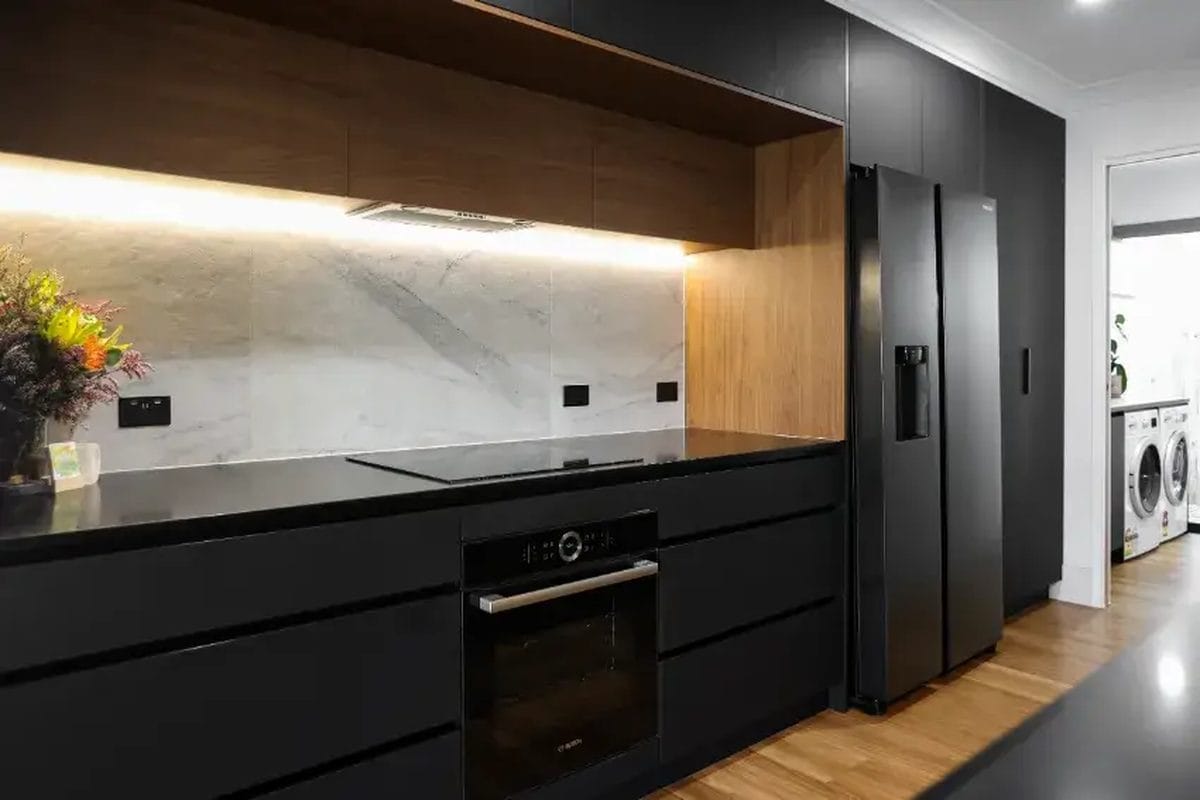
There are four benchtop edge profiles we cut most often. Tight Form, 10/10, Round, and Square. They look similar in a brochure. They feel completely different in a finished kitchen. Here’s how to pick.
Tight Form
A micro-radius edge. The tightest curve that can be safely routed without chipping the laminate. It reads as almost-square from a distance but is soft to touch. Our most popular profile for new builds.
When to choose it: modern kitchens, handleless and finger-pull designs, anywhere you want minimalism without the hardness of a pure square edge. Works at all three thicknesses (21/33/38mm) and with every laminate range we stock.
10/10
A soft rounded edge where the top and bottom of the benchtop are both gently radiused (the “10” refers to the radius in millimetres). Forgiving on small hands and sleeves. Feels casual rather than formal.
When to choose it: family kitchens, rental properties, anywhere small children will be spending time near the benchtop, laundries where you’re leaning against it for long periods.
Round
Full-radius traditional edge. The classic. Top curves fully around to the bottom face of the benchtop. Reads as timeless. Pairs well with shaker doors and farmhouse styling.
When to choose it: traditional, Hamptons, country styling, kitchens in older homes where a modern square edge would look out of place.
Square Edge
Sharp, clean, architectural. Top and bottom of the benchtop both meet at 90 degrees. Needs high-quality joining work because there’s nowhere for imperfect mitres to hide.
When to choose it: contemporary, minimalist, design-led kitchens where the benchtop is part of the statement. Best in 33mm or 38mm thickness. 21mm looks thin at this profile.
Matching edge to door style
The rule of thumb: match the edge to the door it’s sitting next to.
- Shaker or raised panel → Round or 10/10
- Slab, handleless, finger-pull → Tight Form or Square
- Mixed style (one run slab, one run shaker) → 10/10 is the safe neutral
Thickness choice
We cut in 21mm, 33mm and 38mm. 33mm is the standard most kitchens use. 38mm for heavier-use zones like big islands where you want the benchtop to feel substantial. 21mm for smaller jobs, laundries, vanities, or when you want a deliberately light look.
Enjoyed this? Get the next one.
Subscribe to the JournalWhat we cut for.
Every job through our Meadowbrook workshop, cut to ±0.1mm, edged on EVA, ready to install.
See solution
Shaker, slab, handleless, waterfall benchtops. Full kitchens from our Meadowbrook workshop.
Read more → VanitiesSee solution
Floor-mount or wall-hung, single or double basin, integrated drawer banks. Stone-look laminate or full custom finish.
Read more → Alfresco and BBQSee solution
Outdoor kitchens, BBQ housings, beverage runs. Marine-grade fixings, weather-rated decor options.
Read more → MaterialsOrder a swatch pack
Polytec, Laminex, StyleLite. $29 delivered, refunded against your first $300 order.
See samples →